
Model providers used for a SillyTavern preset
Asked which provider they used with GLM 5.3 for a SillyTavern preset, LugerCarrier said they had previously used AIHubMix and another model gateway before trying a Nano subscription.

Access models from OpenAI, Anthropic, Google, and other providers through one API gateway.
By AIHubMix, LLC

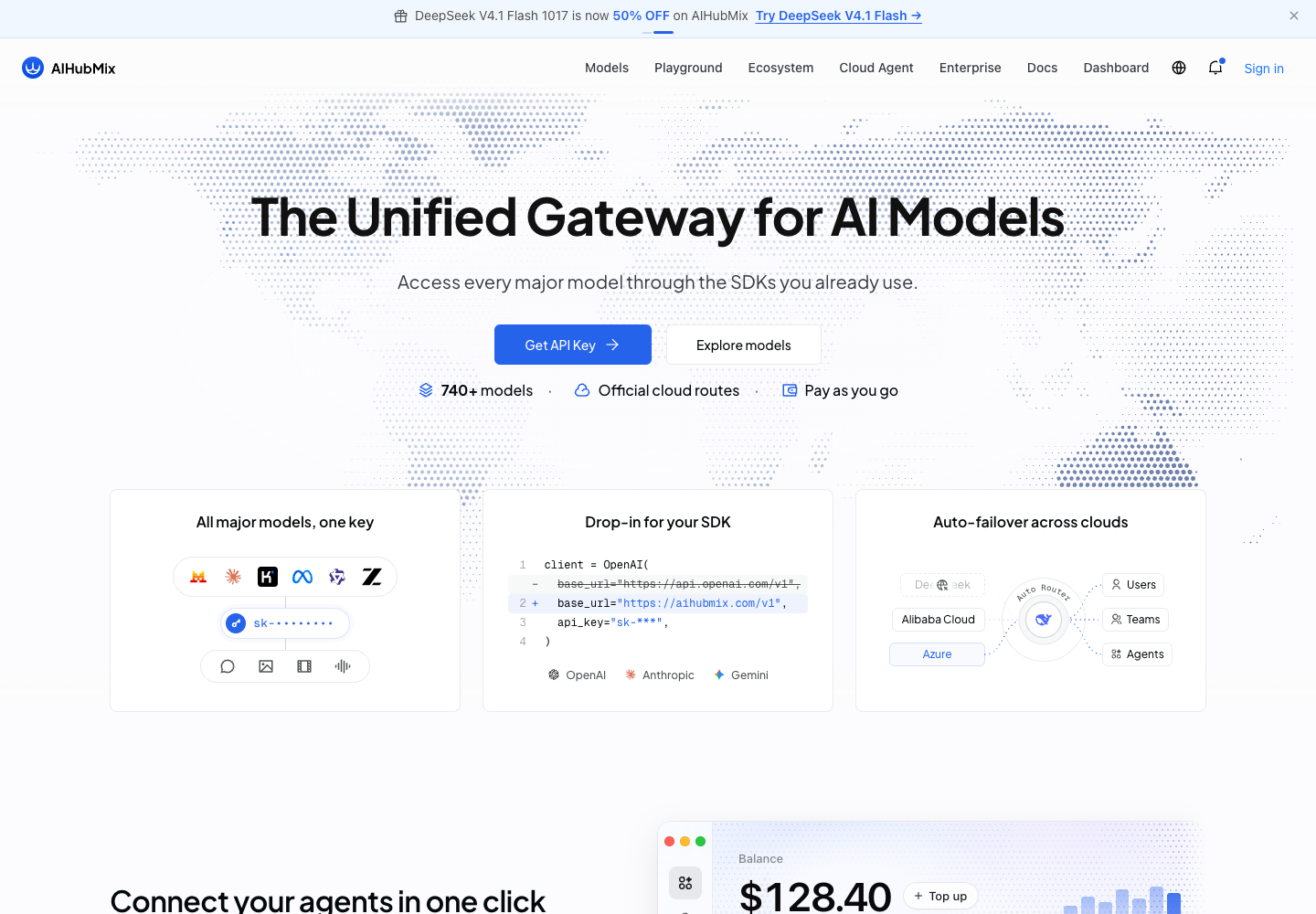
Configure the official OpenAI client with base_url set to https://aihubmix.com/v1 and an AIHubMix API key to call POST /v1/chat/completions across supported providers by changing only the model ID.
Choose a model from the catalog or use the Auto router. AIHubMix also advertises automatic failover across cloud routes.
Send one text passage or a batch to the embeddings endpoint. It returns a vector for each input, which your application can store and compare.
Submit a prompt and a supported video model to the video endpoint. The service creates a task ID so the application can check progress and fetch the finished clip.
Choose a hard spending limit for a workspace or have the service notify recipients at a threshold. Individual API keys can have their own limits within the shared balance.
AIHubMix charges by usage and lists some free models. Below are 20 models with published rates, in the order shown in the official catalog. M means one million tokens. Starting prices can vary by model settings. Check the official catalog for current rates.
Initialize the official OpenAI client with api_key set to your AIHubMix API key and base_url set to https://aihubmix.com/v1, then call client.chat.completions.create with any supported model ID from the AIHubMix model catalog.
The catalog includes models from OpenAI, Anthropic, Google, DeepSeek, Doubao, and Qwen. Copy the exact ID from the listing and check its supported endpoint before sending a request.
Yes. The embeddings endpoint accepts an array of text strings and returns indexed vectors. Use the index to match each vector with its source text, and check the chosen model’s input limit before batching long documents.
Submit a request to POST /ai/v1/videos and save the returned task ID. Poll the task until it completes, then download the result. Available settings, such as duration or resolution, depend on the selected model.
Periodic limits reset in UTC regardless of your browser time zone: Daily limits reset at 00:00 UTC each day, Weekly limits reset at 00:00 UTC on Monday, Monthly limits reset at 00:00 UTC on the first day of the month, and Lifetime limits do not reset.
Requests are restricted when the shared balance, a workspace hard limit, or an individual key allowance is exhausted. Check all three when diagnosing a spending-limit error. An alert-only workspace threshold sends a notification and lets requests continue while sufficient allowance remains.
Public experiences and discussions, with links to the originals.
aloha said they used Gemini 4 Hydrogen through AIHubMix to generate a procedural Three.js animation in one pass. A follow-up reports a generation time of 4 minutes and 38 seconds for that run.
xRogue_Element said they used DeepSeek V4.1 Flash 1017 through AIHubMix for nearly a week. They found it fast and inexpensive for generating code, but said they often needed a more expensive model to fix code that would not run.
K2S said they hit a usage limit while trying DeepSeek V4.1 Flash on AIHubMix. They asked another user about paid and free access. K2S’s own access tier and the limit they encountered were unspecified.
Important_Figure_836 ran the same task once per model through AIHubMix. They reported $0.459 and 2,078 seconds for GLM 5.3, $0.034 and 1,912 seconds for GLM 5.3 Flash, and $0.002 and 14 seconds for DeepSeek V4 Flash 0731. The runs used no retries or manual corrections.
Explore 7 products that share at least one second-level category.
View all 7 alternativesFound something incorrect? Suggest a correction for our editors. It’s free; no account or email is needed.